Artwork
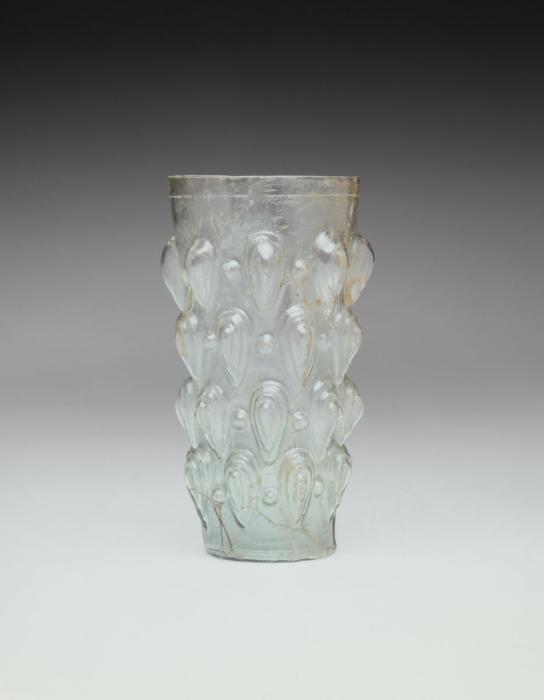
Beaker
DepartmentAncient Mediterranean Art
CultureRoman
Date1st century A.D.
MediumGlass
Dimensionsh. 5 1/8 in. (13 cm)
rim diam. 2 9/16 in. (6.5 cm)
base diam. 1 13/16 in. (4.6 cm)
rim diam. 2 9/16 in. (6.5 cm)
base diam. 1 13/16 in. (4.6 cm)
Credit LinePurchased with funds provided by Mrs. Marie Smith Schwartz
Object number92.77.1
GeographyDescriptionMold-blown beaker of light green glass. The cup was blown in a three-part mold. The design on the body consists of four rows of almond-shaped bosses or knobs, interspersed with small raised dots. There is a single incised band below the plain, lathe-polished rim. The base is a fourth molded piece of glass decorated with a pattern of concentric circles.Label TextThe raised knobs on this conical beaker may have been intended to resemble the knots on a tree trunk. Similar cups have been found in many regions of the Roman Empire. They may have evoked the hero Hercules, who carried a wooden club and was renowned for his drinking as well as his mythological labors. Glassworkers made the thin-walled vessel by blowing molten glass into a mold, a technique invented in the first century A.D.
(J. Powers, 2025)Provenancesold by Antiquarium Ltd., New York, to San Antonio Museum of Art, 1992Exhibition History"Poor Man's Crystal: Utilitarian Glass from Ancient Rome, ca. 50 B.C. - A.D. 450," Wesleyan University, Connecticut, March 28- May 25, 2003.“Mediterráneo—Egipto, Grecia y Roma: Vidrio, Escultura y Relieves de la Antigüedad Clasica,” Museo del Vidrio, Monterrey, Mexico, Apr. 27-Nov. 7, 2004.Published ReferencesC. R. Richardson, Poor Man's Crystal: Utilitarian Glass from Ancient Rome, ca. 50 B.C. - A.D. 450 (San Antonio: San Antonio Museum of Art, 2003), cat. no. 13.
On view
Collections


9th-10th century


12th-13th century


The San Antonio Museum of Art is in the process of digitizing its permanent collection. This electronic record was created from historic documentation that does not necessarily reflect SAMA's complete or current knowledge about the object. Review and updating of such records is ongoing.
 This resource has been made possible in part by the National Endowment for the Humanities: Exploring the Human Endeavor.
