Artwork
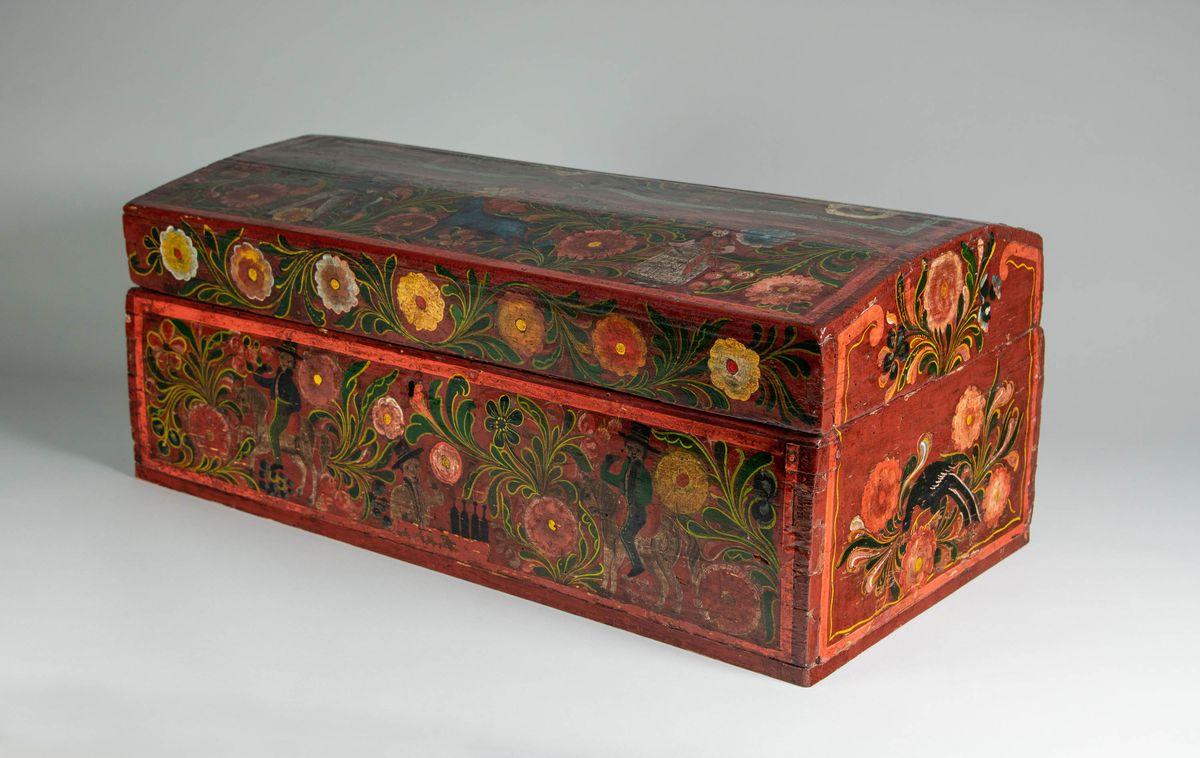
Painted chest
Artist
Unknown
DepartmentLatin American Art
Dateearly- 20th century
MediumPainted wood
Dimensionsh. 12 in. (30.5 cm)
w. 29 in. (73.7 cm)
d. 15 1/2 in. (39.4 cm)
w. 29 in. (73.7 cm)
d. 15 1/2 in. (39.4 cm)
Credit LineSan Antonio Museum of Art, The Nelson A. Rockefeller Mexican Folk Art Collection
Object number85.98.1321
GeographyGeneral regionNorth and Central America
DescriptionA hand-painted and lacquered chest decorated with flowers and foliage. The front of the chest depiects a man at the center, alongside four bottles - made to appear like a bar. There is a man on horseback on either side of this scene. At the top of the chest, there is a man (L) and a woman (R) represented.Label TextOne of the best-known popular art traditions from Olinalá, Guerrero, is its production of lacquered objects, a genre that artists from the region have worked in for several hundred years. The orange base of these lacquered dowry chests specifies them as a works made in Olinalá. By the nineteenth century, chests such as these were made by an assembly line of artisans working on specific aspects of their production.
Una de las tradiciones artísticas más conocidas de Olinalá, Guerrero es la producción de objetos laqueados. Es una industria en la que los artistas de la región han trabajado por siglos. La base color naranja de estos baúles de dote los identifica como obras realizadas en Olinalá. En el siglo XIX, cofres como estos fueron hechos por una línea de ensamblaje de artesanos que trabajaban en aspectos específicos de su producción.
(LA, 2020)Exhibition HistoryCon Cariño: Mexican Folk Art from the Collection of the San Antonio Museum Association (San Antonio Museum of Art), 1986.On view
Collections


18th century


The San Antonio Museum of Art is in the process of digitizing its permanent collection. This electronic record was created from historic documentation that does not necessarily reflect SAMA's complete or current knowledge about the object. Review and updating of such records is ongoing.
 This resource has been made possible in part by the National Endowment for the Humanities: Exploring the Human Endeavor.
