Artwork
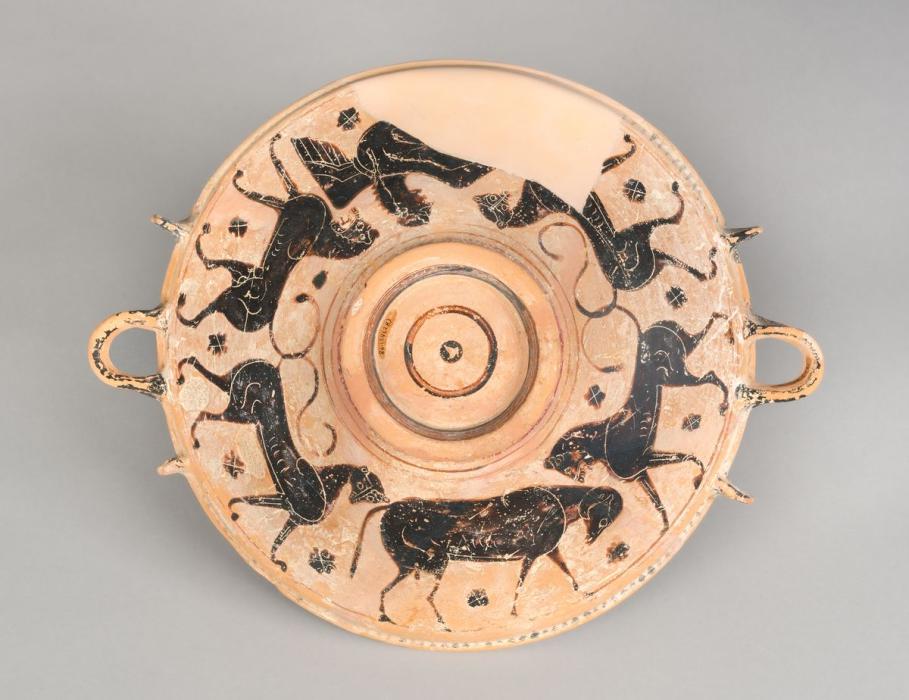


Lekane (shallow dish)
DepartmentAncient Mediterranean Art
CultureGreek
Dateca. 530 B.C.
Dimensionsheight: 2 13/16 in. (7.2 cm)
diameter of rim: 10 7/8 in. (27.6 cm)
diameter with handles: 12 15/16 in. (32.9 cm)
diameter of foot: 3 5/8 in. (9.2 cm)
diameter of rim: 10 7/8 in. (27.6 cm)
diameter with handles: 12 15/16 in. (32.9 cm)
diameter of foot: 3 5/8 in. (9.2 cm)
Credit LineSan Antonio Museum of Art, gift of Gilbert M. Denman, Jr.
Object number86.134.28
GeographyPlace madeGreece
DescriptionA black-figure lekane (a shallow dish) on a circular foot with a vertical rim. A pair of small handles are attached at the rim on either side, and are flanked by projecting handle spurs. Around the exterior are two groups of three animals each, one with a siren between a panther and a lion, the other with a ram between a panther and a lion. Between the animals' legs are incised rosettes. The interior is badly worn; in the central tondo is a lion.Label TextExterior: Animal frieze
Interior: Lion
The Protome Painter was one of the most prolific Boeotian vase painters known, and seems to have specialized in decorating lekanai during the third quarter of the sixth century B.C. This lekane, decorated with an animal frieze on its exterior and a lion on the interior tondo, presents a good example of the animal style favored by the artist.
[G. D. Scott, III, 2002]Provenancesold by Nanette Kelekian (1926-), New York, to Gilbert M. Denman, Jr. (1921-2004), San Antonio, 1982; Gilbert M. Denman, Jr., by gift to San Antonio Museum of Art, 1986Published ReferencesKarl Kilinski II, Boeotian Black-Figure Vase Painting of the Archaic Period (Mainz 1990) Protome Painter no. 27, pl. 26, 5H.A. Shapiro, C.A. Picon, and G.D. Scott, III, eds., Greek Vases in the San Antonio Museum of Art (San Antonio, 1995) pp. 64-5, no. 24
Not on view
Collections


Attributed to the Goltyr Painter
Culture: Greek
mid 6th century B.C.


Attributed to the Castellani Painter
Culture: Greek
ca. 550 B.C.

Attributed to the Erlenmeyer Painter
Culture: Greek
ca. 590-580 BC

16th century


The San Antonio Museum of Art is in the process of digitizing its permanent collection. This electronic record was created from historic documentation that does not necessarily reflect SAMA's complete or current knowledge about the object. Review and updating of such records is ongoing.
 This resource has been made possible in part by the National Endowment for the Humanities: Exploring the Human Endeavor.
