Artwork
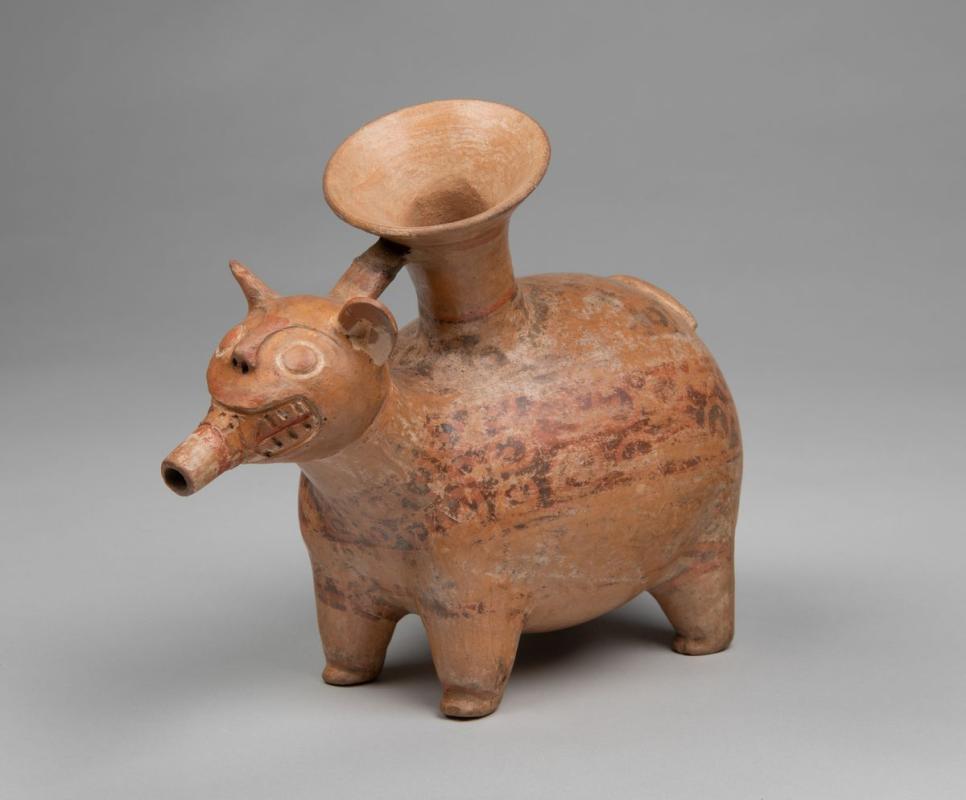
Whistle Vessel
Artist
Unknown
DepartmentLatin American Art
CultureRecuay
Dateca. A.D. 500
Dimensionsh. 7 1/2 in. (19.1 cm)
w. 3 3/4 in. (9.5 cm)
d. 8 1/4 in. (21 cm)
w. 3 3/4 in. (9.5 cm)
d. 8 1/4 in. (21 cm)
Credit LineBequest of Elizabeth Huth Coates
Object number97.1.38
GeographyPlace madePeru
General regionSouth America
DescriptionFigural ceramic vessel in the shape of a mammal standing on all four feet. It is unclear as to what type of animal is depicted but it is more likely to be a feline, fox, or dog. The animal's body is painted red with white resist painted geometric motifs. Within its gaping mouth, with teeth exposed, is a cylindrical object. On the back of the animal is a flared spout set at an angle towards the animal's head. Painted red bands encircle the body of the spout.Label TextThe Recuay lived in the Peruvian highlands and known for a distinct ceramic style that includes the use of white clays, red and black slips, and the application of resist designs, the latter of which occurs in this vessel. The "feline-like" animal depicted is a common motif, but there is debate as to if it is a feline, fox, or dog due to the ambiguity of its form. Regardless, it is likely a supernatural entity in Recuay culture. (Bernadette Cap, 2021)Provenancewith Guillermo Salazar P., Lima, Peru, by 1967; by purchase to Mrs. Elizabeth Huth Coates (nee Maddux) (1909-1996), San Antonio, TX, in 1967; by bequest of the Elizabeth Huth Coates estate to the San Antonio Museum of Art, 1997On view
Collections


Attributed to the Goltyr Painter
Culture: Greek
mid 6th century B.C.


Attributed to the Castellani Painter
Culture: Greek
ca. 550 B.C.


The San Antonio Museum of Art is in the process of digitizing its permanent collection. This electronic record was created from historic documentation that does not necessarily reflect SAMA's complete or current knowledge about the object. Review and updating of such records is ongoing.
 This resource has been made possible in part by the National Endowment for the Humanities: Exploring the Human Endeavor.
