Artwork
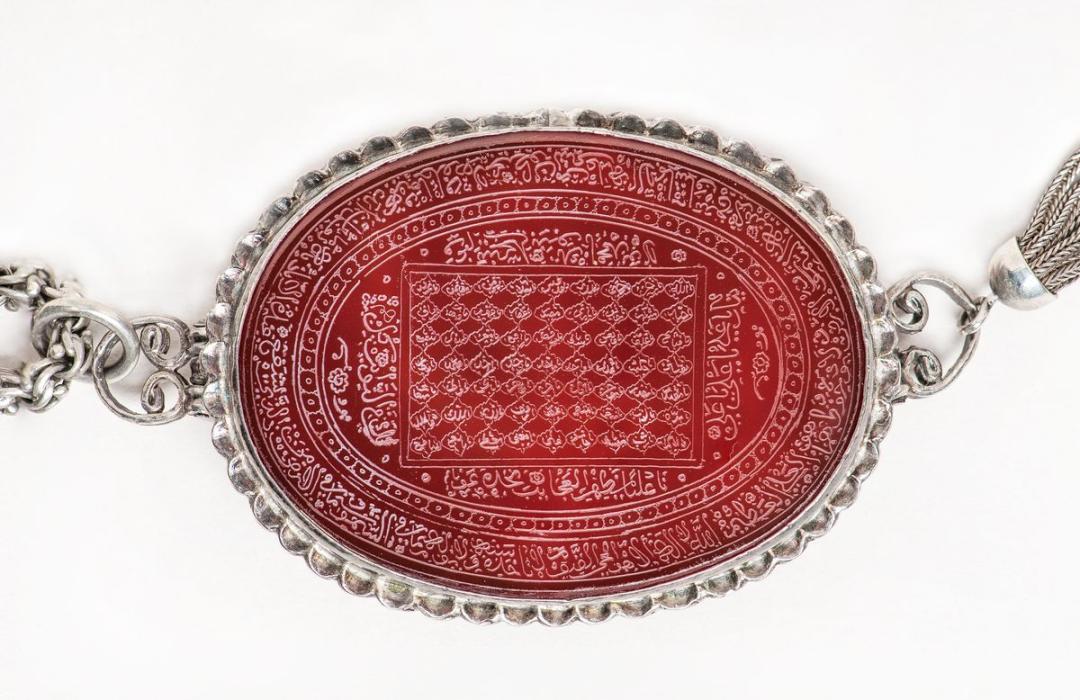


Amulet
DepartmentIslamic Art
Date19th century
DimensionsAmulet: 1 1/2 × 2 × 1/2 in. (3.8 × 5.1 × 1.3 cm)
overall length, with chain and mount: 16 9/16 in. (42 cm)
overall length, with chain and mount: 16 9/16 in. (42 cm)
Credit LineSan Antonio Museum of Art, gift of Anne Wallace in memory of her grandmother Lucile Matthews Brittingham
Object number2013.19
GeographyPlace madeIran or India
DescriptionOval carnelian amulet, set in a silver mount with attached chain. The amulet is inscribed in Arabic with 63 Names of God arranged in diamond-shaped enclosures in a 9 x 7 grid. Around these is a rectangle with a double border, with a Shi'a prayer (the Nad'i 'Ali) inscribed outside its four sides: "Call upon 'Ali who makes wonders appear, you will find him a help to you in adversity, all care and grief will clear away through your friendship, O 'Ali, O 'Ali, O 'Ali". Surrounding these inscriptions is an oval band of floral motifs. Around the perimeter of the amulet is Qur'an verse 2:255 (the Throne Verse).Label TextFor centuries many Muslims have worn intricately inscribed amulets to invoke divine protection and ward off harm. Three Arabic inscriptions cover this extraordinary amulet's surface. In small compartments within the central rectangle are listed sixty-three Names of God, believed to bring blessings. These are surrounded by a Shi’a prayer invoking the aid of the Imam ‘Ali, the cousin and son-in-law of the Prophet Muhammad. The Qur'an verse encircling the amulet's perimeter, known as the Throne Verse, praises the omnipotence of God. This verse was frequently inscribed on amulets because of its power.
Three Arabic texts are inscribed on the amulet’s surface:
1. Qur’an 2:255 (the Throne Verse):
Allah! There is no god [worthy of worship] except Him, the Ever-Living, All-Sustaining. Neither drowsiness nor sleep overtakes Him. To Him belongs whatever is in the heavens and whatever is on the earth. Who could possibly intercede with Him without His permission? He [fully] knows what is ahead of them and what is behind them, but no one can grasp any of His knowledge, except what He wills [to reveal]. His Seat encompasses the heavens and the earth, and the preservation of both does not tire Him. For He is the Most High, the Greatest.
2. A Shi’a prayer invoking the Imam ‘Ali:
Call upon ‘Ali who makes wonders appear, you will find him a help to you in adversity, all care and grief will clear away through your friendship, O ‘Ali, O ‘Ali, O ‘Ali.
3. Compartments in a 9 x 7 grid with 63 of the 99 Names of God.
(J. Powers, 2021)ProvenanceLucile Matthews Brittingham (1890-1995), Fort Worth; by descent to her granddaughter, Anne Wallace, San Antonio; by gift to the San Antonio Museum of Art, 2013Exhibition History40 Years, 40 Stories: Treasures and New Discoveries from SAMA’s Collection, San Antonio Museum of Art, Oct.16, 2021-Jan. 2, 2022Published ReferencesJ. Powers, ed., Still Brewing Art: Making the San Antonio Museum of Art (San Antonio: San Antonio Museum of Art, 2025), p. 96, no. 32.InscriptionsThree Arabic texts are inscribed on the amulet’s surface:
1. Around the perimeter is Qur’an 2:255 (the Throne Verse):
Allah! There is no god [worthy of worship] except Him, the Ever-Living, All-Sustaining. Neither drowsiness nor sleep overtakes Him. To Him belongs whatever is in the heavens and whatever is on the earth. Who could possibly intercede with Him without His permission? He [fully] knows what is ahead of them and what is behind them, but no one can grasp any of His knowledge, except what He wills [to reveal]. His Seat encompasses the heavens and the earth, and the preservation of both does not tire Him. For He is the Most High, the Greatest.
2. Around the central rectangle is the Nad-i 'Ali (a Shi’a prayer invoking the Imam ‘Ali):
Call upon ‘Ali who makes wonders appear, you will find him a help to you in adversity, all care and grief will clear away through your friendship, O ‘Ali, O ‘Ali, O ‘Ali.
3. In compartments in the central rectangle, arranged in a 9 x 7 grid, are 63 of the 99 Names of God.
(Translated with the assistance of Yasmine el-Saleh (2013) and Michael Chagnon (2021).Not on view
Collections


9th-10th century


The San Antonio Museum of Art is in the process of digitizing its permanent collection. This electronic record was created from historic documentation that does not necessarily reflect SAMA's complete or current knowledge about the object. Review and updating of such records is ongoing.
 This resource has been made possible in part by the National Endowment for the Humanities: Exploring the Human Endeavor.
