Artwork
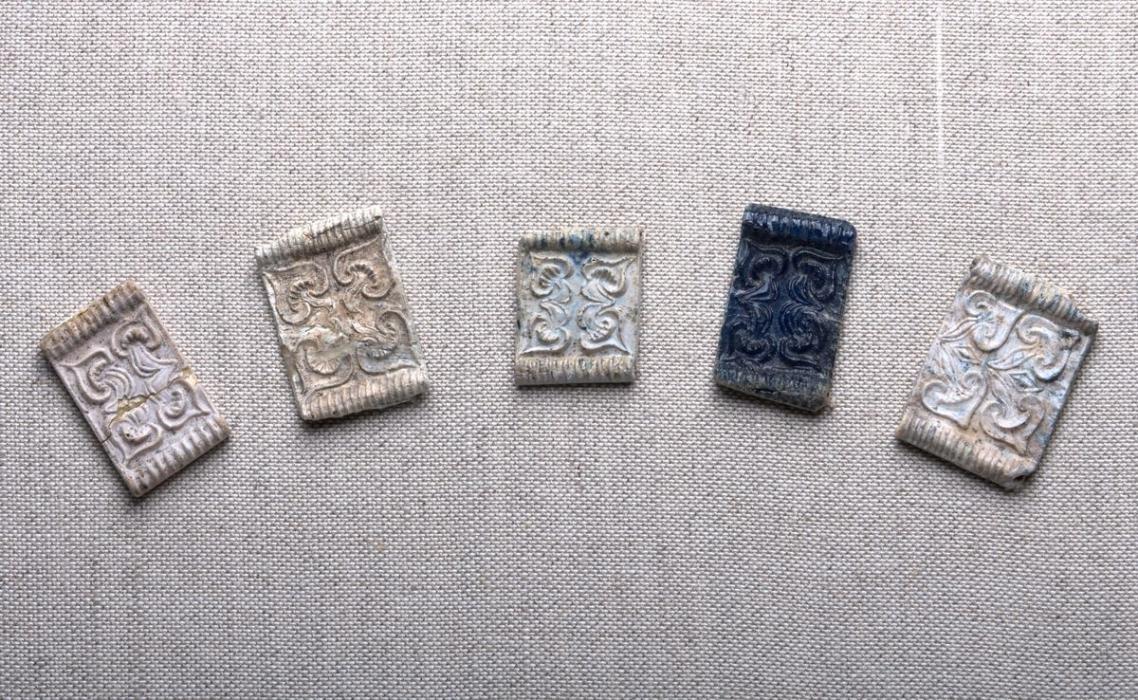


Beads with ivy-leaf patterns
DepartmentAncient Mediterranean Art
CultureMycenaean
Dateca. 1400-1300 B.C.
MediumGlass
Dimensionsa: 1 7/16 × 1 in. (3.6 × 2.5 cm)
b: 1 5/16 × 13/16 in. (3.3 × 2 cm)
c: 1 1/16 × 13/16 in. (2.7 × 2.1 cm)
d: 1 5/16 × 1 1/8 in. (3.4 × 2.8 cm)
e: 1 1/4 × 13/16 in. (3.2 × 2 cm)
b: 1 5/16 × 13/16 in. (3.3 × 2 cm)
c: 1 1/16 × 13/16 in. (2.7 × 2.1 cm)
d: 1 5/16 × 1 1/8 in. (3.4 × 2.8 cm)
e: 1 1/4 × 13/16 in. (3.2 × 2 cm)
Credit LinePurchased with funds provided by Mrs. Marie Smith Schwartz
Object number89.74.1.a-e
DescriptionFive mold-made beads of dark blue glass, four of which have weathered to a whitish color. The decoration on each consists of four outward-pointed ivy leaves, one at each corner. Each bead has a border of vertical ribs at top and bottom; these borders have horizontal openings that served as string holes for the attachment of the beads.Label TextWorn by wealthy Mycenaeans, beads or plaques like these could be strung on a necklace or attached to diadems or garments. The dark blue glass, which has weathered to white on several of the plaques, was cast in stone molds to create the pattern of ivy leaves in relief. Analysis of similar beads has found that the blue glass was produced in Egypt and then shipped to Mycenaean sites, including Mycenae and Knossos, where the beads were manufactured. (J. Powers, 2017)ProvenanceErnst Kofler and Marta Truniger, Lucerne, by 1956; Christie's, London, March 5-6, 1985, lot 285; sold by Robin Symes, London, to San Antonio Museum of Art, 1989Published ReferencesHelmhaus Zürich, Glas aus vier Jahrtausenden (Zürich: Kunstgewerbemuseum, 1956), no. 2.Karl Schefold, Meisterwerke griechischer Kunst (Benno Schwabe & Co., 1960), 308, no. 553.
Sammlung E. und M. Kofler-Truniger, Luzern. (Kunsthaus Zürich, 1964), 47, no. 453.
Beat Rütti, 3000 Jahre Glaskunst (Luzern: Kunstmuseum, 1981), 42, no. 40.
Christie's, London, March 5-6, 1985, lot 285.
On view
Collections


mid- 20th century


The San Antonio Museum of Art is in the process of digitizing its permanent collection. This electronic record was created from historic documentation that does not necessarily reflect SAMA's complete or current knowledge about the object. Review and updating of such records is ongoing.
 This resource has been made possible in part by the National Endowment for the Humanities: Exploring the Human Endeavor.
