Artwork
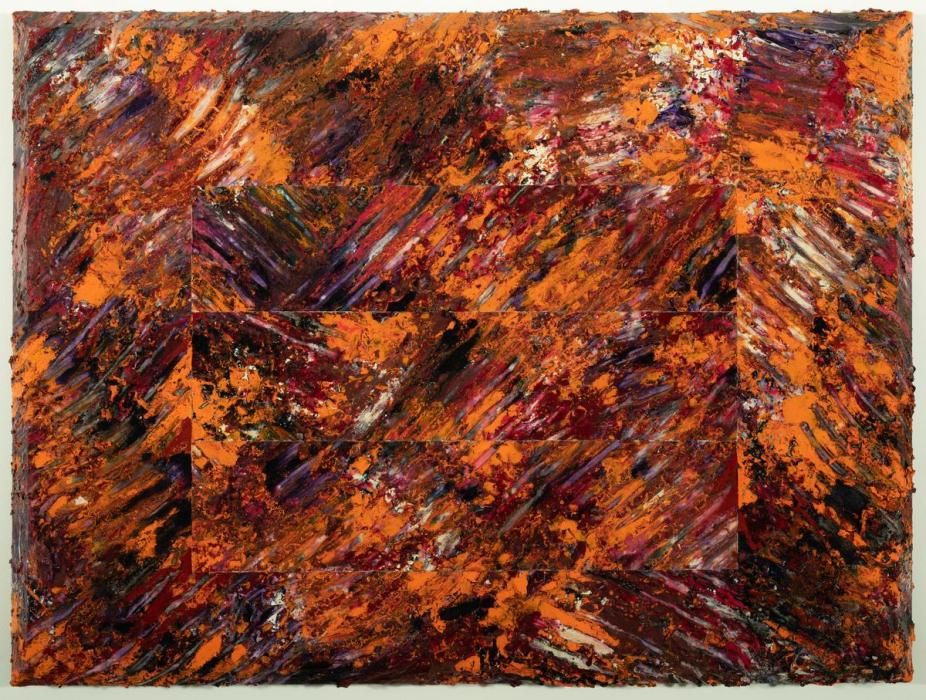
Glow-Sprite
Artist
Sam Gilliam
(American, 1933 - 2022)
DepartmentContemporary Art
Date1979
Dimensions30 x 40 1/4 in. (76.2 x 102.2 cm)
Credit LineSan Antonio Museum of Art, gift of Elizabeth and Meyer Lifschitz in memory of Pearl and George Bronz
Object number97.6
Copyright© Sam Gilliam
GeographyPlace madeUnited States
DescriptionAbstract painting with thickly applied paint in an allover composition with predominant hues of bright orange, red, and purple. Passages of parallel lines are present throughout.Label TextChallenging the distinction between painting and sculpture, Sam Gilliam’s canvas is richly textured with a beveled edge. After building up layers of pigment, Gilliam raked across the surface of the canvas to reveal the hues underneath. The canvas was then cut into sections, which were reconstructed into smaller paintings like this one. During the 1960s, Gilliam became associated with the Washington Color School—artists that pursued experimental painting techniques to achieve abstract compositions of pure color. Gilliam is known for his spatial innovations, such as large-scale unstretched canvases soaked and stained with vibrant paint colors and hung in voluminous drapes.
(Lana Meador, 2021)
"My formula has always been one of change . . . .
It's really a matter of confidence and of gut
instincts. I'll take a chance on losing everything
in order to gain something else. As a result, I
usually gain, because all of my experiences and
methods are cumulative."
Sam Gilliam
In late 1960s, Gilliam became the first African-American to earn national acclaim as an innovator in the history of abstract painting. At that time, Gilliam was already staining his canvases with acrylic paint, a favored technique among his peers in Washington D.C., where he still lives and works today. The artist first experimented with folding and rolling the canvases to create vertical stripe configurations and hanging them on stretchers with beveled edges, so they jutted outward from the wall. He then came up with the idea of suspending the canvases like draperies, completely free of any frames. His paintings, thus, became hybrids of painting and sculpture, with factors such as location or the pull of gravity determining a work's actual shape.
By the 1970s, Gilliam had moved on to other new ideas. Seeking to bring the thick surfaces of abstract expressionist painting back into his work, he used a crusty paint made by combining acrylic paint with Rhoplex, a dense acrylic-based resin. One series consisted of paintings made through a process of deconstruction and reconstruction. After building up a thick surface on a large canvas and raking through it to create textured ridges, Gilliam cut the work into smaller sections and then reconfigured them to form new paintings. In this example, three cut-out horizontal bands were attached to a thin support to form the center of the composition. The bands are surrounded by a larger section, cut from an earlier painting, which serves as both a framing device and part of the depicted imagery.
(David Rubin, Label Text 2008)Not on view


Alma Nungarrayi Granites
Culture: Aboriginal Australians (Warlpiri language group)
2007


The San Antonio Museum of Art is in the process of digitizing its permanent collection. This electronic record was created from historic documentation that does not necessarily reflect SAMA's complete or current knowledge about the object. Review and updating of such records is ongoing.
 This resource has been made possible in part by the National Endowment for the Humanities: Exploring the Human Endeavor.
