Artwork
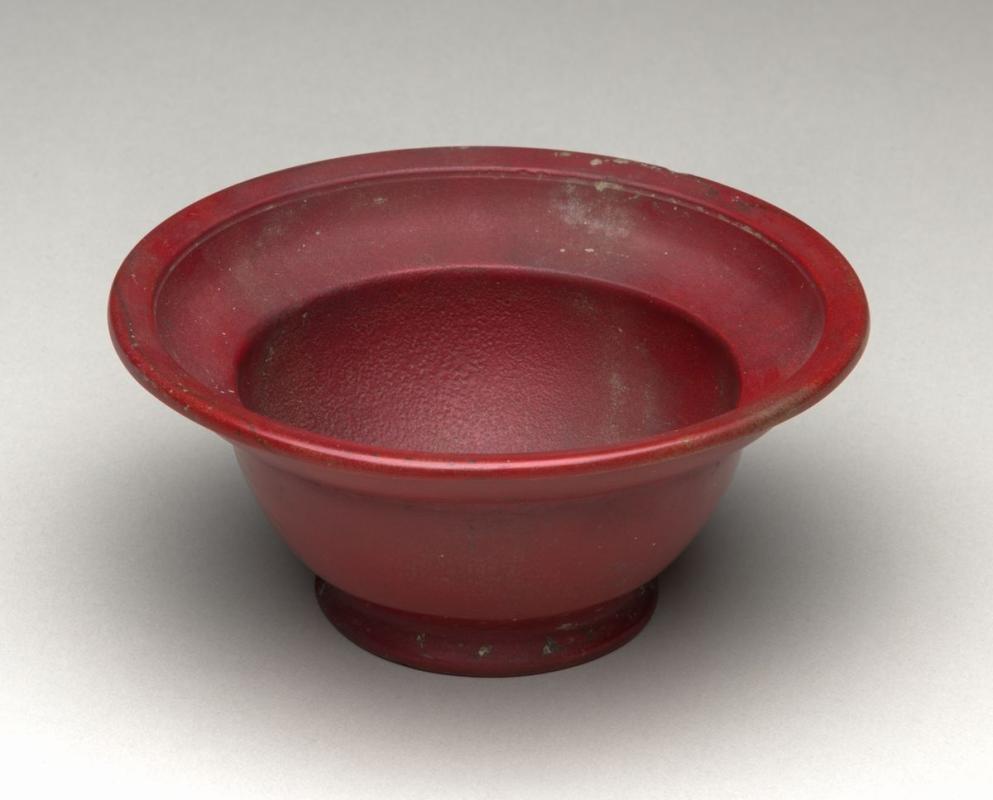


Cup
DepartmentAncient Mediterranean Art
CultureRoman
Dateearly 1st century A.D.
MediumGlass
Dimensionsheight: 1 11/16 in. (4.3 cm)
diameter of rim: 3 3/4 in. (9.5 cm)
diameter of foot: 1 3/4 in. (4.4 cm)
diameter of rim: 3 3/4 in. (9.5 cm)
diameter of foot: 1 3/4 in. (4.4 cm)
Credit LineMuseum Purchase: Stark-Willson Collection
Object number86.138.331
DescriptionCast patella cup of opaque ruby red glass. Double-convex form, with the upper bulge rather small and angular. Thin, flat rim and low, angular, added coil foot. Sharp articulation of the various sections. The rim was ground with a lathe, and the interior of the vessel polished.Label TextFine tableware in the Roman world included vessels in glass as well as other materials such as silver, bronze, and pottery. These glass drinking cups were cast in molds to create crisp shapes with precisely curved contours—a form made in pottery as well as glass. Glassmakers fashioned opaque cups like this one in vivid colors, including blue, green, white, and the striking dark red of this example.
(J. Powers, 2025)Provenanceby purchase, the Stark family, Orange, Texas, between 1927 and 1929; by bequest, the Nelda C. and H. J. Lutcher Stark Foundation, 1965; by purchase, the San Antonio Museum of Art with funding from Mr. and Mrs. Robert Willson, 1986Exhibition History"Poor Man's Crystal: Utilitarian Glass from Ancient Rome, ca. 50 B.C. - A.D. 450," Wesleyan University, Connecticut, March 28 - May 25, 2003.“Mediterráneo—Egipto, Grecia y Roma: Vidrio, Escultura y Relieves de la Antigüedad Clasica,” Museo del Vidrio, Monterrey, Mexico, Apr. 27-Nov. 7, 2004.Published ReferencesC. R. Richardson, Poor Man's Crystal: Utilitarian Glass from Ancient Rome, ca. 50 B.C. - A.D. 450 (San Antonio, 2003), cat. no. 7a.
On view
Collections


9th-10th century A.D.


Unknown
Culture: Lima-Nievería/Provincial Wari
ca. A.D. 600-1000


The San Antonio Museum of Art is in the process of digitizing its permanent collection. This electronic record was created from historic documentation that does not necessarily reflect SAMA's complete or current knowledge about the object. Review and updating of such records is ongoing.
 This resource has been made possible in part by the National Endowment for the Humanities: Exploring the Human Endeavor.
