Artwork


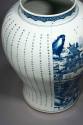


Jar
DepartmentAsian Art
CultureChinese
Date1720
Dimensions28 x 19 5/16 in. (71.1 x 49.1 cm)
Credit LineSan Antonio Museum of Art, gift of Lenora and Walter F. Brown
Object number92.25.49
GeographyPlace madeJingdezhen, Jiangxi province, China, Asia
DescriptionOne rare and very large Kangxi baluster vase painted in underglaze blue with scenes of a mountain pavilion in an extensive river landscape on one side, and the Chinese inscription of a poem written by Wang Bo on the other side. A copy of the translation of the poem is attached in file.Label TextOne side of this massive jar shows the Pavilion of Prince Teng (Tengwang Ge) in a mountainous landscape beside the Gan river in Nanchang, Jiangxi province. Prince Teng (tengwang), a son of Tang Emperor Gau Zu (r. 618-626), was the first occupant of the Pavilion (ge) and the site is named after him.
The text on the reverse commemorates a party held at the Pavilion on October 3, 675. The preface and poem, by Tang poet Wang Bo (ca. 650-676) provides details about the festivities, and is one of the most revered literary works of the Tang dynasty.
The poem reads:
The lofty Pavilion of Prince Teng looks down upon islets in the river,
Jade pendants and carriage bells, the songs and dances, are all over now;
In the morning, painted beams soar like clouds over the South Bank,
In the evening, vermillion shades roll up like rain above West Mountain.
Leisurely, clouds are reflected in deep pools, as the days go by,
The scene changes, stars shift - how many autumns have passed?
The pavilion's prince - where is he now?
Beyond the railing, the lengthy river selflessly flows by.
An inscription dates the jar to the autumn of the gengzi year, approximately 1720. The Pavilion of Prince Teng was a conventional subject in Chinese painting by the fourteenth century, and on other ceramic wares by middle of the Qing dynasty.
(Label text, October 2014)Exhibition HistoryThe Hero in World Art: Selections from the San Antonio Museum of Art1. Art Museum of Southeast Texas, Beaumont, 1 December 1995 - 28 August 1996
2. San Angelo Museum of Fine Art, San Angelo, 21 November 1996 - 21 December 1997
San Antonio Museum of Art, San Antonio, Scrolling Lotus: 500 Years of Chinese Blue and White Porcelain, 1 February 2003 - 29 February 2004
San Antonio Museum of Art, San Antonio, Legacy of Beauty: An Exhibition of Chinese Ceramics in Honor of Walter F. Brown, 2014
On view
Collections


The San Antonio Museum of Art is in the process of digitizing its permanent collection. This electronic record was created from historic documentation that does not necessarily reflect SAMA's complete or current knowledge about the object. Review and updating of such records is ongoing.
 This resource has been made possible in part by the National Endowment for the Humanities: Exploring the Human Endeavor.
